Lilian Kroth
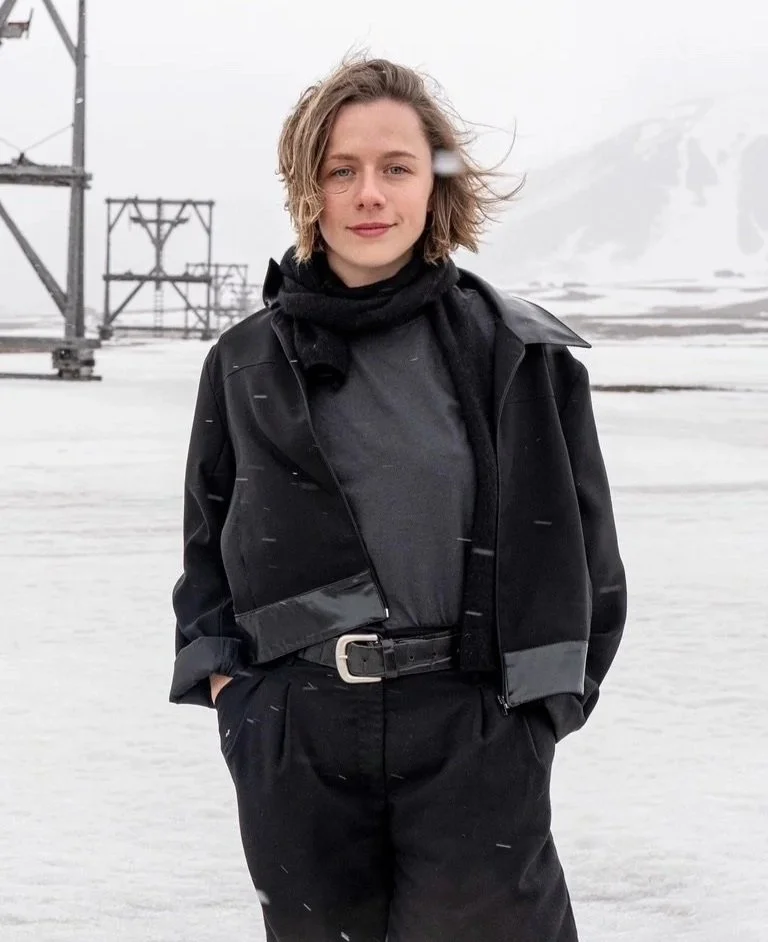
In residence: March 2026
Lilian Kroth is a researcher working at the intersection of philosophy, science, and aesthetic practice. Her work explores how the natural world is understood through concepts, scientific instruments, and visual methods, with a particular focus on climate, Earth observation, and remote sensing technologies. She is currently affiliated with the Philosophy Department at University of Fribourg, where she contributes to the Swiss National Science Foundation–funded projects Aerial Spatial Revolution and Seeing like a Satellite, and is a member of the research group Aesthetics & Critique.
Kroth received her PhD from University of Cambridge in 2023. Her doctoral research examined concepts of limits, boundaries, and frontiers as interdisciplinary formations in the work of philosopher of science Michel Serres. She studied Philosophy at the University of Vienna and Fine Arts at the Academy of Fine Arts Vienna, a dual background that continues to shape her engagement with drawing as both a philosophical and aesthetic method. Between 2021 and 2024, she was an associated researcher at the Centre Marc Bloch in Berlin, working within the research groups Energy and Climate and Critical Thinking in the Plural, and was also affiliated with the University of Groningen. While in Cambridge, she co-organised the CRASSH Research Network Remote Sensing: Ice, Instruments, Imagination, convening interdisciplinary discussions on satellite vision and polar environments.
Central to Kroth’s practice is an interest in how concepts travel between disciplines and how they shape methods, aesthetics, and ways of knowing. In particular, she engages with drawing as a way of thinking—an epistemic device that both reflects and generates knowledge. Drawing, which appears across philosophical texts, scientific visualisation, and artistic practice, functions in her work as a critical tool for probing the relations between embodied perception and technologically mediated forms of seeing.
During her residency in Svalbard, Kroth will develop the project Seeing Ice Like a Satellite, which investigates how satellite imagery mediates contemporary understandings of glaciers and cryospheric ecologies. While satellite images play a crucial role in communicating climate change, their apparent objectivity can obscure the complex processes, abstractions, and interpretations through which such images are produced. Working with the gap between the visible and the visualisable, and between ground-based experience and orbital vision, Kroth will use drawing as a critical research practice to explore what it means to ‘see’ ice through the satellite’s eye.
Through engagement with in-situ perspectives, satellite ground infrastructures, scientific visualisation strategies, and the metaphors used to describe satellite vision, drawing will be mobilised in multiple registers—from diagrams of spectral data and composite image gaps to figurative studies of instruments and icy terrain. By foregrounding drawing as a method of grounding satellite vision, the project aims to make visible the hidden processes, assumptions, and limits embedded in remote sensing technologies, contributing to broader conversations around climate data literacy, aesthetics, and contemporary ways of seeing.
Instagram: @lilian_kroth
This residency is supported by: