
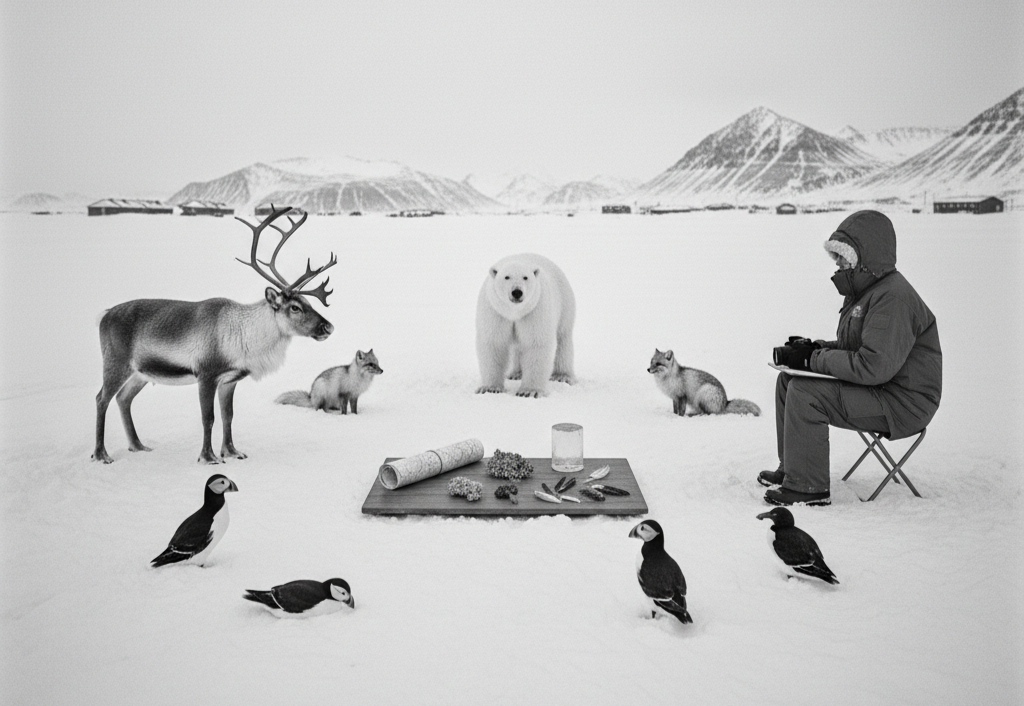
Noah’s ark 2.0: Who will speak for the reindeer?
Imagineering Svalbard adaptation pathways based on ethics of care
As the most rapidly warming place in the world, deep adaptation in Svalbard will be paramount for all species currently living on the archipelago.
So far adaptation planning in Svalbard and elsewhere is primarily anthropocentric. The Svalbard reindeer, which set foot on the archipelago approximately 7000 years ago following the retreat of glaciers, has much to teach humans due to its unparalleled thermoregulation and adaptation capacities. What if we decentered our gaze and attempted to speak for the reindeer to design coadaptation policies based on ethics of care?
Drawing on her experience as a researcher, writer and futurist, artist-in-residence Celine Charveriat, founder of Pro(to)topia, invites inhabitants of Svalbard to join a series of two workshops.
Dates: Thursday 21 May and Thursday 28 May
Time: Both workshops run from 17:30 - 19:30
The workshops build on one another, and participants are therefore encouraged to attend both.
Location: Artica Svalbard, Vei 608-3
What to Bring: If you have an object or picture or anything related with Svalbard reindeers that you would like to add to our collection of prompts for the first workshop, please bring it along.
To book: workshops@articasvalbard.no
Participants: max 8, open to all. No prior expert knowledge of reindeers required.
The workshop will be followed by a dinner with Indian and French home cooked food, please let us know when booking if you can join for food.
What to expect:
After a short introduction regarding ethics of care applied to climate adaptation, the first workshop will invite participants to decenter their gaze as humans and imagine what non-humans, especially the Svalbard reindeer, need and want in the context of adaptation to climate change. The second workshop will introduce strategic foresight scenarios for 2037 and invite participants to practice ethics of care by speaking for the reindeer and discussing implications for adaptation policies and governance in Svalbard. The outcomes of the workshop will be published online and serve as a basis for further work on futuring and ethics of care for adaptation to climate change in Svalbard and beyond.