
How to Get Lost in the Tundra by Kathy Sirico
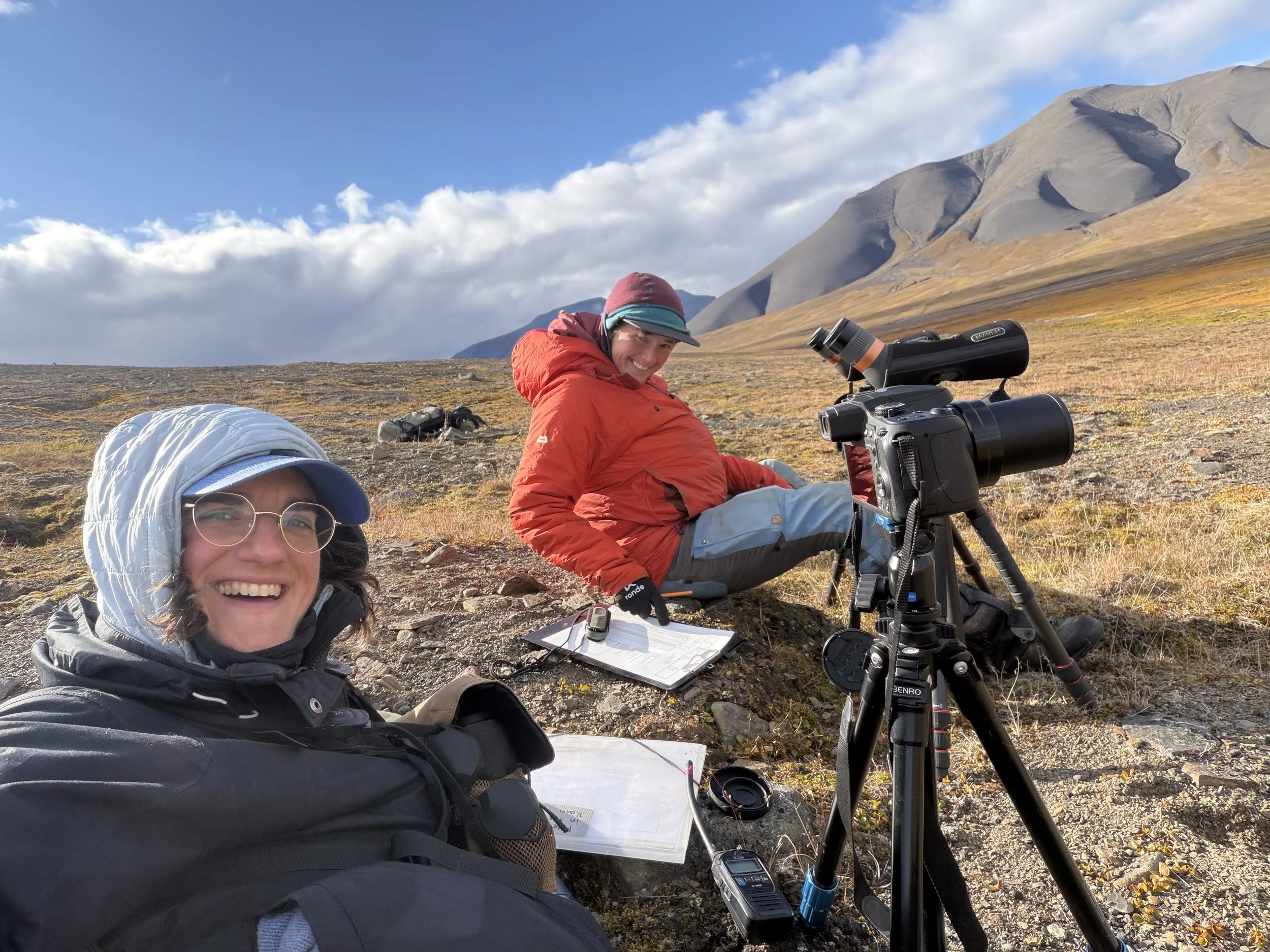
Walkie-talkie in hand and foraging kit slung over my shoulder, I set out into the open tundra. Sam and I have been following GPS-collared reindeer all day, moving through a now familiar pattern—find the reindeer in question, get close enough to set up scopes and cameras, record thirty-minute to hour-long minute-by-minute behavioral observations, or watch until said reindeer has a particularly visible meal and an even more visible poop. Then, it is time to collect.
Sam, project lead to whom I am both field assistant and artist-in-resident, stays behind, marking the spot with her eyes through the scope and directing me there through the walkie talkie. I hike for a while in the direction I think I’m going.
“Stop right there,” comes Sam’s voice, gravely through radio. “Take three big steps to the left. Okay, good, now walk directly away from me…No, one big step to the right…okay, keep walking away from me.” I continue on until I hear, “Stop, okay, now place your left hand on the ground just ahead of you, between your boots…yes…it should be around there.”
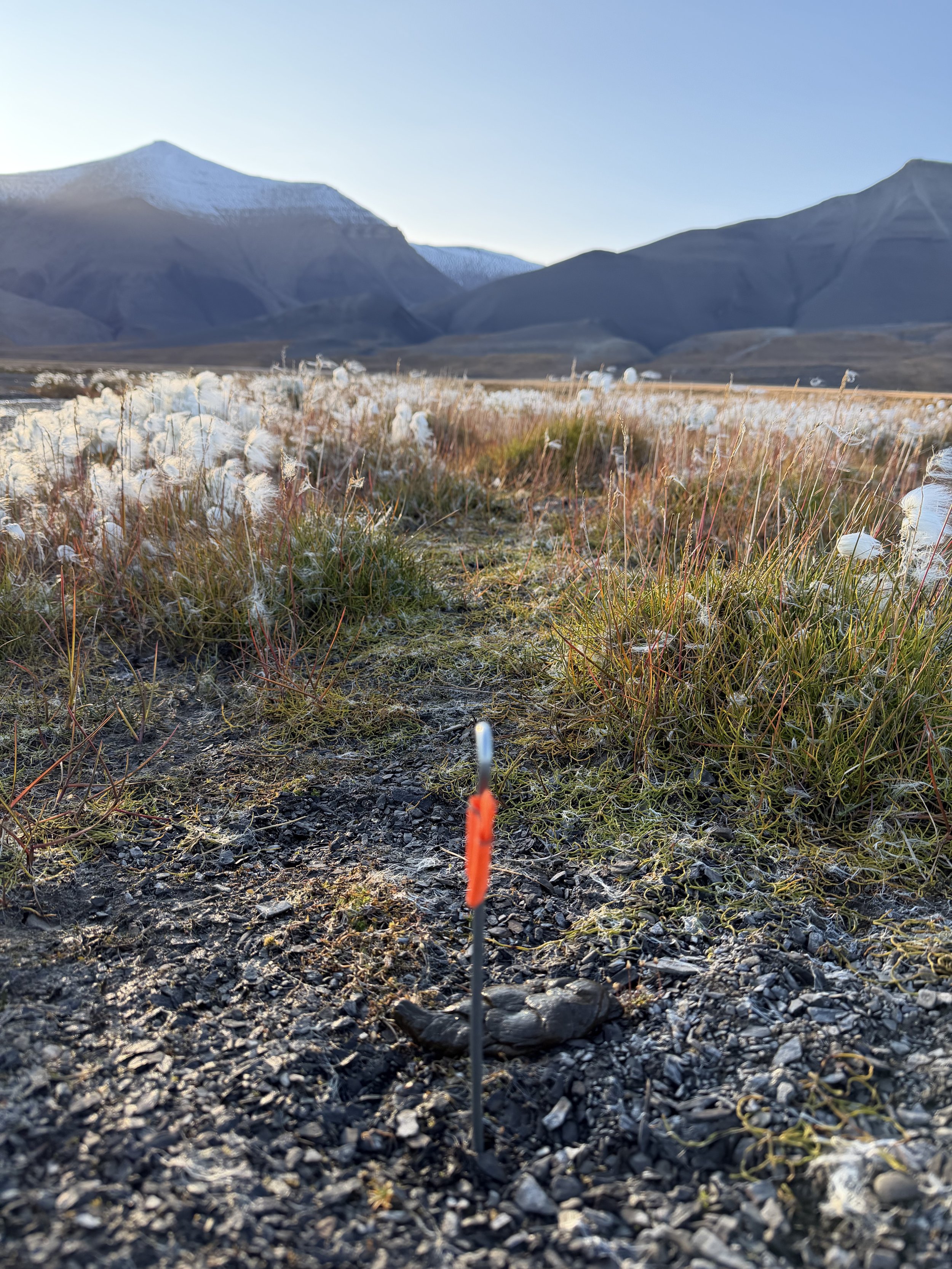
It’s time to look for fresh reindeer poop, which is distinctly wetter and smoother than its dried out, pelleted counterpart. Most of the time, Sam is impressively good at sending me directly to the poop we are looking for. “Found it,” I report into the walkie-talkie as I push the pointed end of a diy flag—a metal skewer with orange duct tape on the top—into the earth next to it to mark the spot. Then, I set out again, repeating the same process until we find the foraging location where our reindeer was grazing. On my knees, face an inch away from the ground, I look for fresh bite marks on specific grasses and shrubs. Into the earth, another flag.
Now it’s time for me to go back to the poop to collect it into two separate bags to send to the lab for testing. But where was the first flag? And where, exactly, was I? Which direction had I come from? Why did the dip in the silhouette of the mountain I’d mentally marked that seemed so obvious to me from a distance suddenly change shape, move even?
I turn around in a circle, squinting hard behind me to look for Sam. I can’t find her. Then, there she is, small as a dot in the distance. How far had I walked? Where was that tiny flag I had just planted…was it a minute ago? Ten minutes ago? Was I an optimistic but perhaps terrible field assistant? Or just one of two humans in Svalbard’s largest valley, navigating the kind of wild that summons you like a trickster, luring you out again and again into its vastness.
Here’s a tundra truth: looking at a landscape and moving through one are completely different realities. Terrain, thick with textured grasses and swampy swaths of marshland, hillsides, streams, and hidden drops, looks flat from far away. Watch a reindeer through the scope and suddenly, she disappears down a ridge we didn’t even know was there. A foraging spot that seems close may take twenty minutes to reach. And that patch of eriophorum we are trying to locate isn’t a patch at all—it’s a wide expanse with a few cottony flowers here and there that distance has shaped into an illusion of closeness.
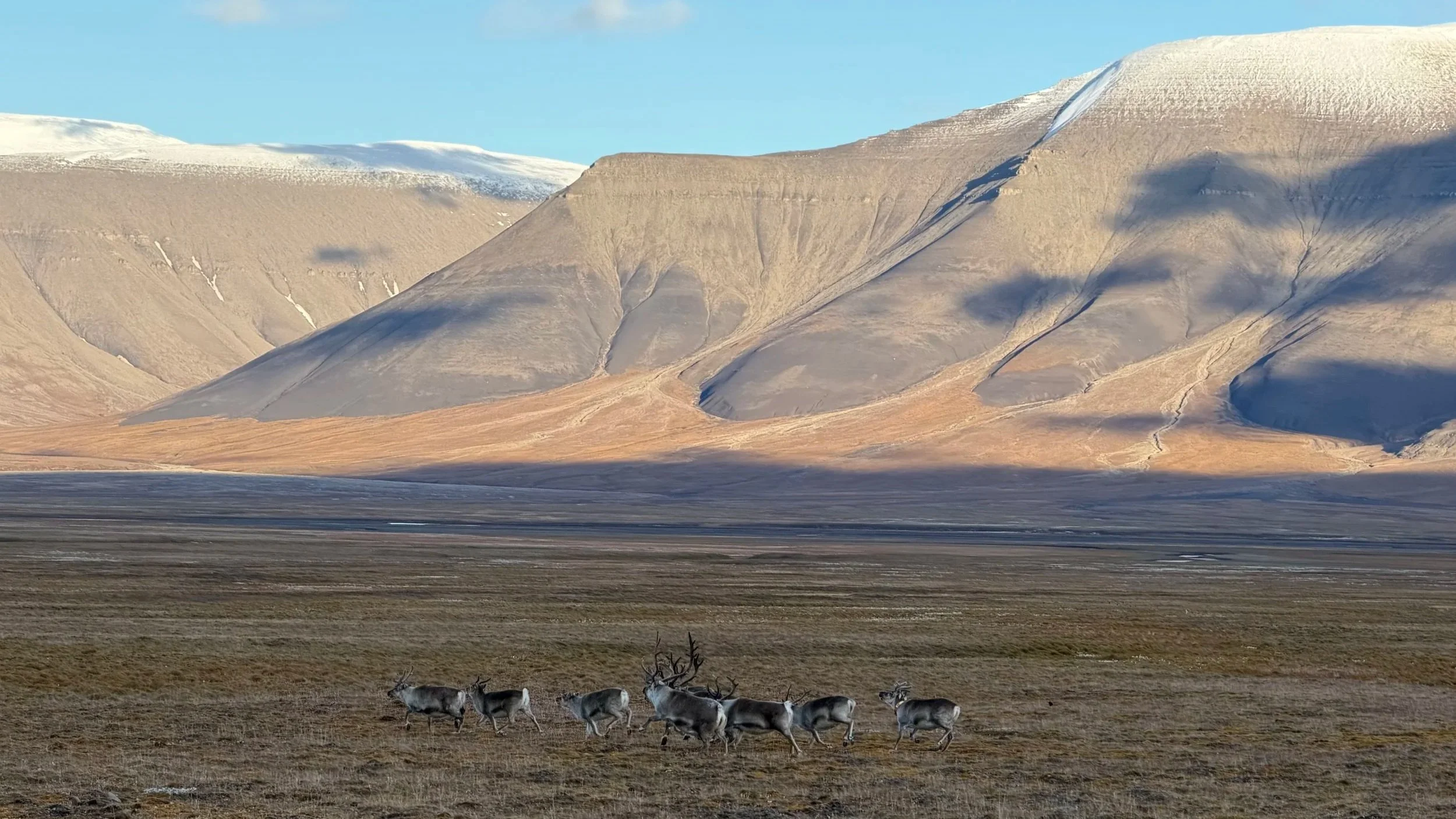
As an artist, the color immersion of this effect is magnetic—luzula, salix, carex, and other arctic plants collapse into layers of blended color, luminous hues of golden ochres bleeding into shades of dark purples and earthy umbers. I could stare for hours, making paintings in my mind, figuring out how I’d mix pigments to capture what I’m seeing, taking mental pictures, and thinking of all the artists who have come before me and have tried to capture the inexpressible immersion of self and landscape.
But they weren’t walking through the tundra. Daydream the day away but your knees will remind you of your body and how real it all is. Aching left shoulder, bruise on the right hip, knees feeling things they’ve never felt before—everything I knew about walking feels irrelevant. One step and I am on hard rock. Another, I land calf-deep in swamp. The water is sometimes clear, sometimes murky with floating feces, sometimes electric green with algae, other times sulphuric rust orange. Piles of moss rise above these waters like little sponge hills. I swing my left leg upward and, with the helpful physics of hiking poles and my newly ripped biceps, I hop moss pile to moss pile to avoid an accidental swim. The moss compresses gradually beneath my feet, and the slow and sensual sink of body into moss becomes addictive fun. I am so grateful for these moss piles that I become enamored with them. When I see them, I must walk on them. I start to greet them aloud, my little moss friends. I wonder about them and begin to ask questions. What exactly is moss? How many kinds are there? What do they like to do? Why are they here? Why am I here?
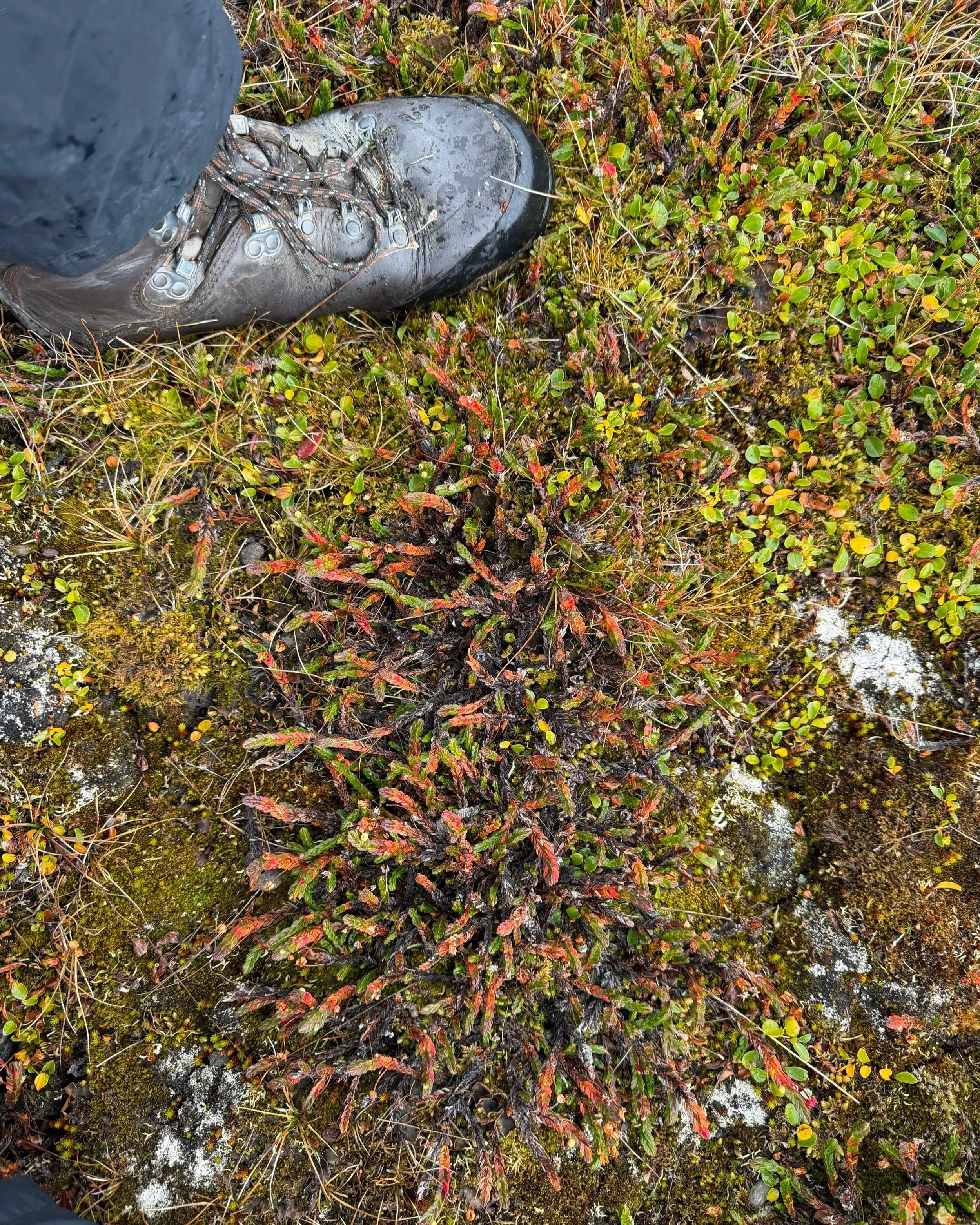
I study it up close, à la naturalist. Each pile is a miniature kingdom of plant life. Some moss has structures like tiny forks, others little blooms in more shades of green than we can count. Some are so golden, they glow.
Curiosity about moss leads to curiosity about lichen, then lichen to rock, rock to moraine, moraine to glacier, glacier to fjord, to wind, to skies, to wings, to pink footed geese and purple sandpipers and golden plovers and suddenly there is so much to meet and witness and observe. It is thrilling and impossible. A month in the field does not feel like enough time to honor them, just like how a photograph of a landscape has little to do with the landscape itself. I take pictures in my mind, forcing myself to remember everything, to remember every detail at every scale. I cannot help but become lost, lost in the tundra of my own experience.
Sam has reached me now, has carefully counted the plants within the ten-centimeter square foraging plot to see what our reindeer has been eating today. The valley runs east to west, she explains, in an effort to save future me from disorientation. In my artist’s heart, I know it won’t.
So, she hands me a bag of cashews. “Hungry?” she asks, throwing me the chocolate bar she knows I like. We sit together, two small creatures at the top of the world, snuggling the dog and drinking hot water sweetened with Norwegian solbær syrup from our thermoses. The sky has been changing at night recently. Soft pink light hugs the tips of the clouds as the last days of summer sunlight illuminate the mountains. It is the kind of color you can get lost in.
Kathy Sirico was in residence at the Tarandus field cabin from July - August 2026