
Inside the Glacier: Artists at Larsbreen
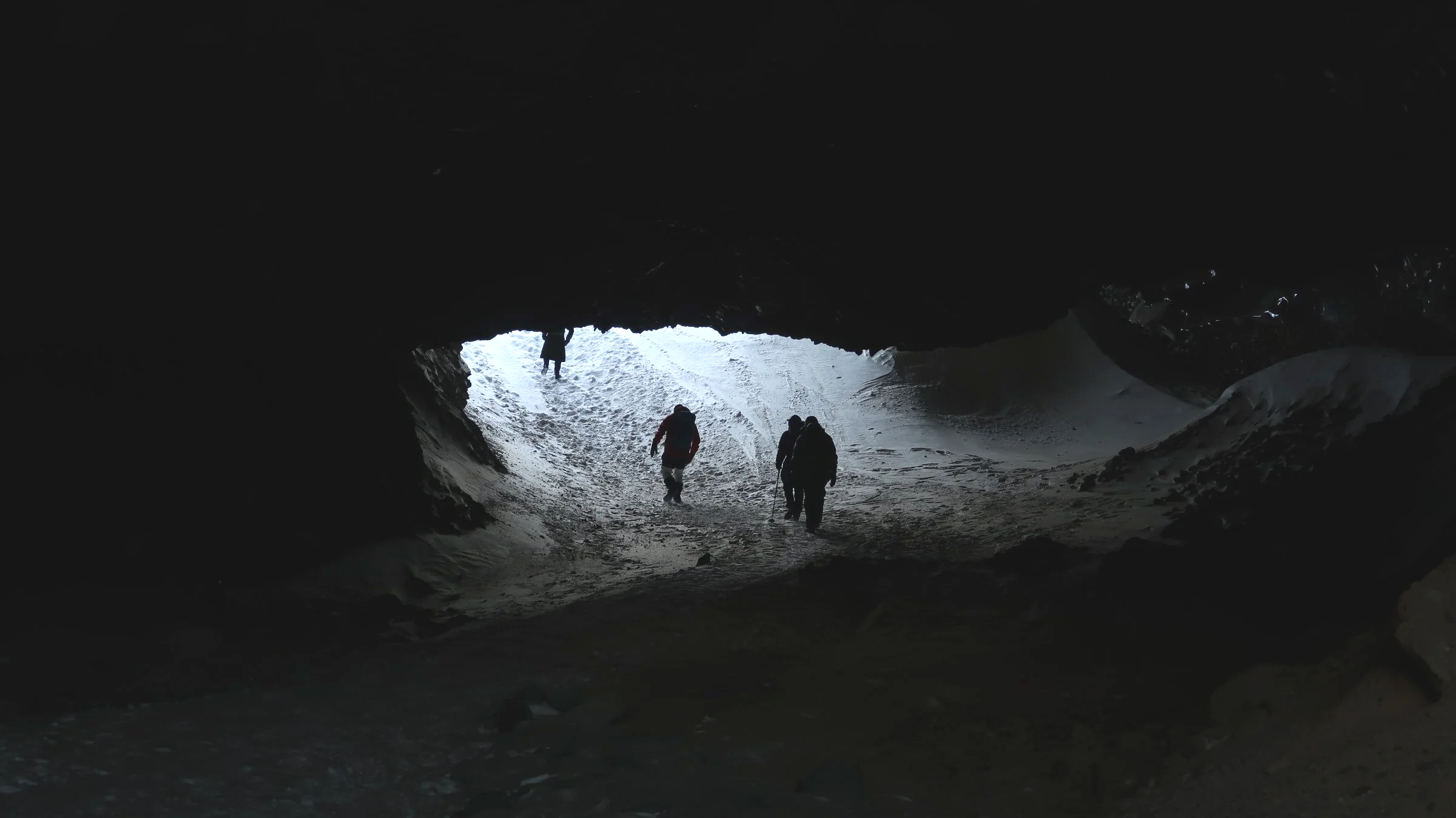
Residents Mhairi Killin, Thomas Abercromby, and Lilian Kroth, together with Residency Coordinator Sally Hovelsø, set out on a field trip to the ice cave at Larsbreen, a glacier on the northern slope of Lars Hiertafjellet at the head of Longyeardalen.
The visit was initiated by Killin as part of her ongoing residency research. Working across drawing, print, sculpture, and film, Killin’s practice explores the fragile and interconnected relationships between land, sea, humans, and other beings. Returning to Artica Svalbard for a third residency, she continues to develop connections between Svalbard and her home on the Isle of Iona in the Inner Hebrides.
During her current stay, Killin is developing work as part of the collaborative project From the Mouths of the Caves – Listening to Hear Another Island’s Song. The project draws on the resonance between two elemental sites—an ice cave in Svalbard and a sea cave on Iona—exploring how knowledge, memory, and ecological awareness move between island environments.
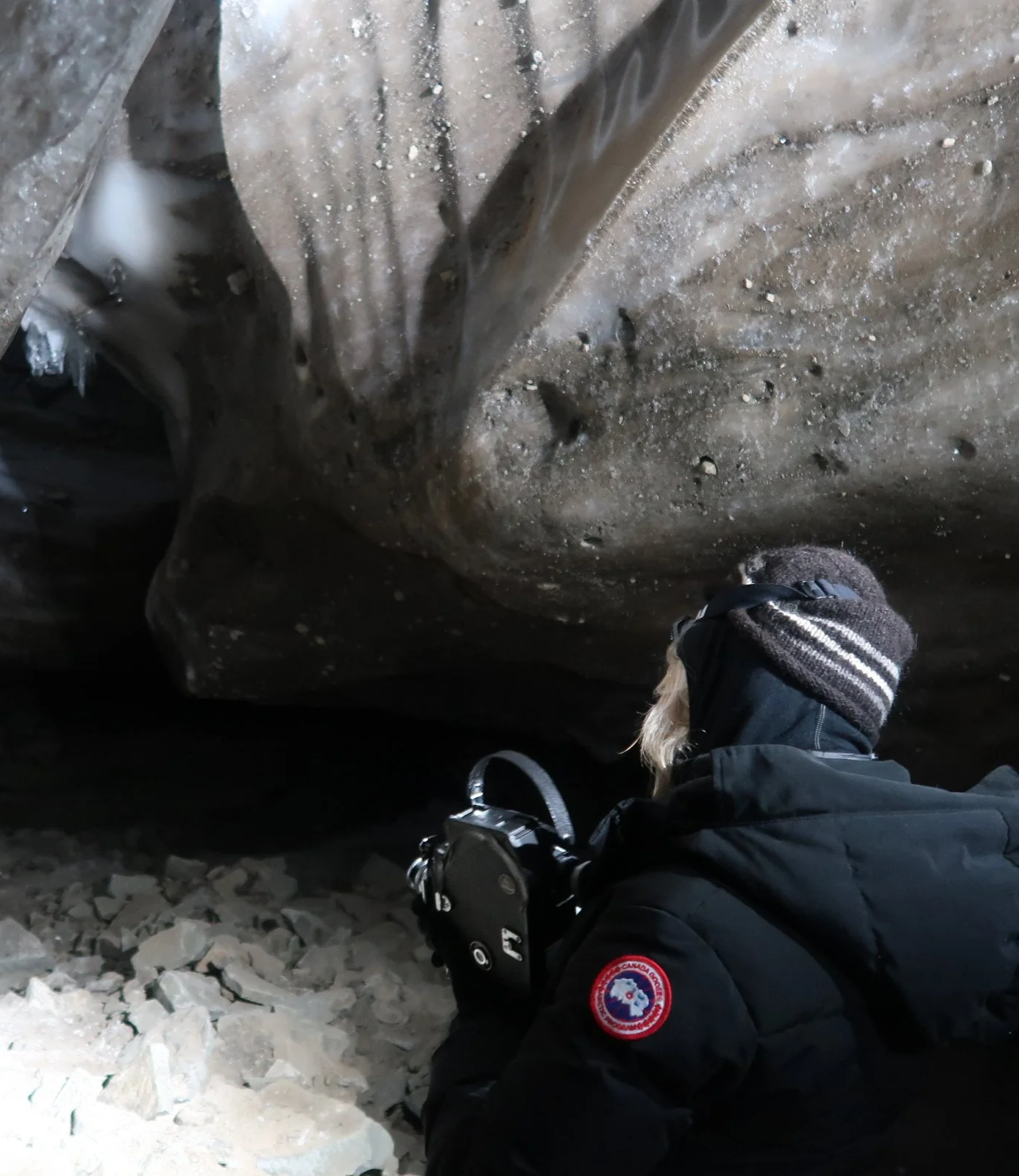
Reflecting on the experience of entering the cave and working within it, Killin shared:
“The entrance to the cave was reached by climbing backwards through a small tunnel and working our way down a passage of snow steps. As daylight receded, my thoughts moved between the immediate need to watch my footing and a growing doubt about the improbable task ahead; trying to work with a 16mm Bolex camera in freezing temperatures, in the dark, beneath a glacier.
Once able to stand in the body of the cave, we momentarily switched off our head torches and stood in silence and darkness in the meltwater belly of the glacier. Impressions of the organic forms of the ice cave were still imprinted on the inside of my eyelids, creating an interior landscape, not of total darkness but of shifting shadow and form. Standing briefly in this carved space, I thought of the sea caves at home on Iona and felt a sense of why darkness was such a visionary force in early Gaelic culture: a generative environment in which perception shifts and encounters with other forms of knowledge might become possible.
With the help of my fellow artists, who lit the walls of the cave with their head torches, I ran the film through the camera, its mechanical whirring at odds with the silent, ephemeral atmosphere of the cave. These research specific field trips are central to how I’ve been able to engage with the Svalbard environment, and this kind of collective encounter feels integral to the residency: not only as field research, but as a form of holding space for one another within a demanding and changing environment.”
Such field-based excursions form an important part of Artica Svalbard’s residency programme, supporting artists in engaging directly with the landscapes, conditions, and material realities of the High Arctic.