
Written by Siri Granum Carson, October 2025
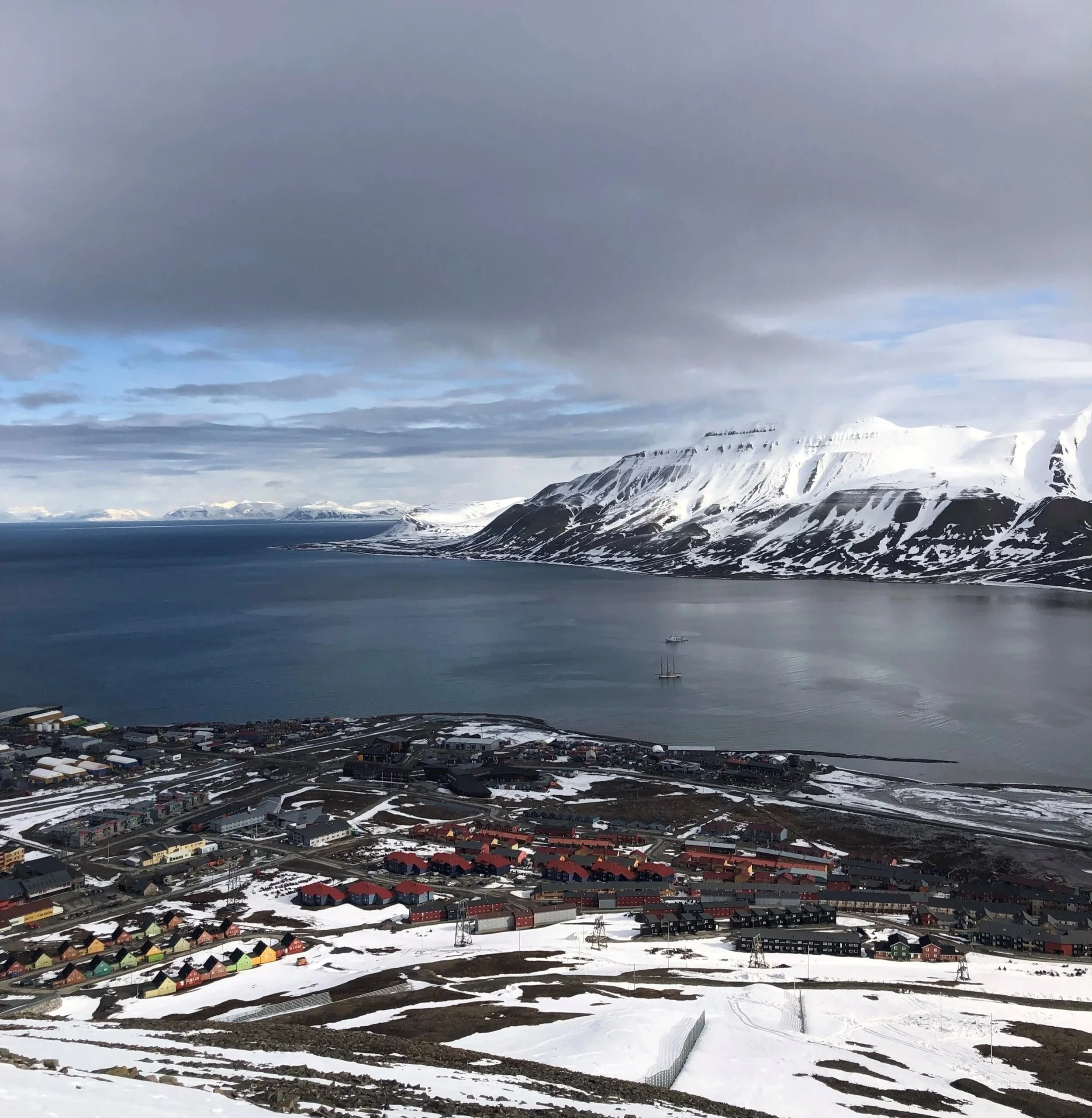
A view of Longyearbyen, looking out towards the Isfjorden in May 2023 Photo by: Eva Hilde Murvold
Engaging in the extractive future of Svalbard – A Manual
The prospect of deep-sea mining means potentially continuing the history of Svalbard as a centre for extraction of natural resources. At the same time, Svalbard is developing as a hub for the science of a rapidly changing world – both in the sense of the mounting climate and nature crises and in the sense of growing geopolitical unrest. Who should be involved in shaping the future of Svalbard? Should you, perhaps? How can we restructure the ongoing dialogue on deep-sea mining in a way that invites the participation of a wider register of stakeholders?
The title of this essay clearly promises too much – this small contribution does not present the blueprint or a stepwise recipe for how to build public engagement. It aims rather to be a manual in the alternative meaning: A handy and not-too-heavy piece of training equipment, good for a warm-up exercise in the practice of caring for the future of Svalbard.
Svalbard is heating up – in the literal as well as the metaphorical sense. The effects of climate change are much more dramatic in the Arctic, visible in the form of increasingly turbulent weather conditions and diminishing glaciers. The changing climate as well as more direct effects of human activity – light, sound – impacts species on land and in the Barents Sea (Sundfjord et al., 2025). Research reviewing satellite data over the past decades shows that, in the Arctic, temperature has risen almost four times faster than the global average (Rantanen et al., 2022). Svalbard plays a key role in the concept of “the new Arctic” as it is already relatively ice free compared to, for example, Alaska, and thus, is literally opening up for scientific exploration as well as possibilities of increased commercial activity in the form of shipping, fishery and – potentially – mineral extraction from the sea floor.
The complex history of the archipelago makes Svalbard a “hotspot” for national and international politics There are contentious issues concerning resource utilisation on and around the islands. The Svalbard Treaty recognises Norwegian sovereignty over Spitsbergen and the surrounding islands, while giving all signatories (as of now 48 nations) equal rights to engage in commercial activities in the area. A hundred years ago, at the time of the signing of the Treaty, coal mining was the case at hand. With future mineral exploitation, there are several unresolved questions concerning what kind of regulatory regime this activity will fall under. Meanwhile, Russia’s invasion of Ukraine in 2022 marks the transition to a new and more insecure world order, where the attention to the Arctic region takes on a stronger military flavour in addition to the existing political, commercial, and research interests.
At the same time, there is an increasing urgency concerning the issue of marine protection and restoration. In 2023, the Forum for Integrated Ocean Management submitted an expert report on the scientific basis for Norway’s ocean management plans, suggesting to define the central Barents Sea as one of the “Particularly vulnerable and valuable areas”. As of now, this status does not indicate any specific restriction of commercial development, but it sends a signal that the precautionary principle should be strictly implemented for all activities in the area. Norway is committed to the UN Kunming-Montreal Biodiversity Framework, including the so-called “30 by 30” target, aiming to protect 30% of the world’s ocean by 2030. As of now, Norway has a long way to go until this target is met, and we may ask how an increase of commercial activity in our Arctic Ocean areas can fit into our path towards fulfilling our commitment.
The idea of Svalbard as a future centre for mineral extraction from the seafloor may be seen as the next step in the history of Svalbard as an extractive community. So, how do the people who live in Svalbard position themselves when it comes to this new opportunity? With this question in mind, my colleagues and I organised a public meeting in Longyearbyen in May 2023. The meeting was part of a four-day seminar at the University Centre in Svalbard (UNIS) under the headline “Making Use of Arctic Science”, organised as a part of NTNU’s Ocean Week 2023 in collaboration with UNIS. We invited the local community to join us in a dialogue about sustainable resource extraction in the future Svalbard. This general topic took its concrete starting point in the political process that opens for impending exploration, and eventual extraction, of minerals from the ocean floor in the Barents Sea close to Svalbard. What, we wondered, did the people living in the vicinity of these contested fields think about the opening process?
Shortly before the seminar, the Norwegian Ministry for Oil and Energy completed an impact assessment followed by an open hearing around this topic, where a large number of researchers, NGOs and other concerned parties pointed out the huge knowledge gaps in the field and criticized a rushed opening process and a thinly based environmental assessment. Nevertheless, in June 2023, around a month after our seminar, the government went ahead with their plans and opened an area of 281,000 square kilometres in the Greenland and Barents Sea for mineral exploration.
Internationally, seabed mineral exploration is a highly controversial topic. Nations such as Palau to France, as well as many environmental organisations, large corporations and research environments, all warn about the risk of irreparable damage to vulnerable ecosystems in the deep sea. Other nations, corporations and organisations stress an ever-growing demand for minerals and the prospects of developing a new, profitable industry – in Norway promoted by some as “the new oil”. The champions of developing deep sea mining promote the need for minerals to produce batteries, windmills and other key elements of “the green shift”, and point out a long list of problematic social, environmental and political conditions of existing mineral supply chains. In response, adversaries point out the danger of damaging aquatic biodiversity that in the long run is decisive for the survival of the planet.
The Longyearbyen citizens that showed up at our open meeting at UNIS were curious about the prospects of deep-sea mining. To our surprise, they informed us that the topic was more or less non-existing in the public discourse of Longyearbyen. Meanwhile, the local community’s engagement ran high on a somewhat connected topic – the ongoing dismantling of land-based mining and its consequences for employment and living conditions at Svalbard. One aspect we touched upon was whether a new mining adventure – albeit on the ocean floor rather than on land – could signify a renewed faith in Longyearbyen as an industrious place with a prosperous future ahead of it. Another was that the people living in Longyearbyen are first-row spectators of the changing climate. On the one hand this could point in the direction of a positive attitude to mineral extraction – in the sense that some of these minerals could literally empower the green shift – but on the other hand it could point in the direction of a stronger commitment to protect their surroundings from further exploitation.
Our conversation with the citizens of Longyearbyen dealt with the question of whether sustainable mineral exploitation in the Arctic Ocean is possible. The question is complex, for example, involving the issue of alternatively sourced minerals. As mentioned, current mineral exploration around the world comes with considerable damage, from pollution to slavery. Geopolitical concerns favour an attempt to gain control over the flow of raw materials, but deep-sea mining operations are still packed with all kinds of technological, economic, and environmental uncertainties. Ongoing research points towards the possibility to extract minerals directly from sea water with much lower environmental footprints than from the sea floor (Li et al. 2021; Earle and Kammen 2022), and cool water seems to be a favourable condition for such extraction. Could Svalbard rather become a future hub for such alternative mineral extraction? Perhaps so, if Svalbard continues its development from an “extractive community” into what we may call a “knowledge community”, where UNIS and other research and innovation organizations become increasingly important employers and critical knowledge becomes the new main export goods. Since the establishment of UNIS in 2006, NTNU has collaborated closely with the centre on Arctic research and innovation. In the years to come, a lot of research will take place under the heading of “Arctic Ocean 2050”, a 1 billion NOK, joint Norwegian research initiative focusing on the knowledge needs created by the ongoing transformation of the Arctic Ocean, whereby it is changing its main colour from white to blue. It remains to be seen if this research initiative, to a greater extent than previous knowledge production, will consider the complex value landscapes (and seascapes) and the diversity of stakeholders involved in the issue of resource extraction in the Arctic.
The key question that brought us as researchers together with representatives of the local community of Longyearbyen in 2023 was this: How can we restructure the hot topic of deep-sea mining to welcome a wider register of participants in the important conversations about regulation, benefit sharing, and environmental risk? At present, attention is focused on knowledge gaps concerning Arctic geology and environmental baselines, and how to deal with the risks of industrial activity. These topics prioritise the interests of policymakers, researchers, and businesses to define financial potential as well as ecological limits. But how do we get from here to the level of immediate human engagement with our surroundings? Research shows that we as humans assign ethical value to the ocean and its critters – even the ones we have never encountered and are likely to never encounter (Stabell, 2019). In other words, we do care – but caring is not the same as caring for. Caring for is only possible through practical and emotional involvement and a sense of being able to make a difference. A lesson we (the researchers involved in questions of marine and maritime resource extraction) drew from our discussion in Longyearbyen was that we need to attend to a complex web of values and relations between people and the ocean. This also means including the voices of Longyearbyen. The eyes, ears, minds and hearts of local people should be closely involved in creating the future of Svalbard.
References
Earle, S. and Kammen, D. (2022). The Case Against Deep Seabed Mining. Time Ideas, October 25. https://time.com/6224508/deep-sea-mining-threat-ban/ (downloaded Oct. 8, 2025)
M-2552 (2023). Summary of the scientific basis for Norway’s integrated ocean management plans 2019-2023.
Rantanen, M., Karpechko, A.Y., Lipponen, A. et al. The Arctic has warmed nearly four times faster than the globe since 1979. Commun Earth Environ 3, 168 (2022). https://doi.org/10.1038/s43247-022-00498-3
Stabell, E. D. (2019). Existence value, preference satisfaction, and the ethics of species extinction.
Sundfjord, A., Johnsen, G. and Reigstad, M. (eds.) (2025). The Barents Sea system – Gateway to the changing Arctic. Fagbokforlaget.
Zhen Li et al. (2021). Continuous electrical pumping membrane process for seawater lithium mining. Energy Environ. Sci.,14, 3152-3159.
Å engasjere seg i Svalbards utvinningsfremtid – en manual
Utsiktene til havbunnsgruvedrift innebærer en mulig videreføring av Svalbards historie som et senter for utvinning av naturressurser. Samtidig utvikler Svalbard seg som et knutepunkt for forskning på en verden i rask endring – både med tanke på de økende klima- og naturkrisene, og i lys av økende geopolitisk uro. Hvem bør være med på å forme Svalbards fremtid? Kanskje du? Hvordan kan vi omstrukturere den pågående dialogen om havbunnsgruvedrift slik at flere ulike stemmer blir invitert med i samtalen?
Tittelen på dette essayet lover egentlig for mye – dette lille bidraget presenterer ikke en oppskrift eller en trinnvis plan for hvordan man bygger samfunnsengasjement. Det er snarere ment som en manual i en annen betydning av ordet: Et lite og lett treningsredskap, godt egnet til oppvarming i øvelsen som handler om å bry seg om Svalbards fremtid.
Svalbard blir varmere – både i bokstavelig og overført betydning. Effektene av klimaendringene er langt mer dramatiske i Arktis, synlige i form av stadig mer uforutsigbart vær og minkende isbreer. Det endrede klimaet, sammen med mer direkte menneskelig påvirkning – som lys og lyd – påvirker arter både på land og i Barentshavet (Sundfjord mfl., 2025). Forskning basert på satellittdata viser at temperaturen i Arktis har steget nesten fire ganger raskere enn det globale gjennomsnittet (Rantanen mfl., 2022). Svalbard spiller en nøkkelrolle i forståelsen av «det nye Arktis» ettersom øygruppen allerede er relativt isfri sammenlignet med for eksempel Alaska. Dette gjør området bokstavelig talt mer åpent for vitenskapelig utforskning – men også for økt kommersiell aktivitet som skipsfart, fiske og – potensielt – mineralutvinning fra havbunnen.
Den komplekse historien til øygruppen gjør Svalbard til et «hotspot» for nasjonal og internasjonal politikk. Spørsmål knyttet til ressursutnyttelse på og rundt øyene er ofte omstridte. Svalbardtraktaten anerkjenner Norges suverenitet over Spitsbergen og de omkringliggende øyene, samtidig som alle signatarland (nå 48 nasjoner) har like rettigheter til å drive kommersiell virksomhet i området. For hundre år siden, da traktaten ble undertegnet, var kullgruvedrift temaet. Når det gjelder fremtidig mineralutvinning, er det fortsatt mange uavklarte spørsmål om hvilket regelverk som skal gjelde. Samtidig har Russlands invasjon av Ukraina i 2022 markert overgangen til en ny og mer usikker verdensorden, der interessen for Arktis også får et sterkere militært preg, i tillegg til de politiske, kommersielle og forskningsmessige interessene som allerede finnes.
Samtidig øker behovet for vern og restaurering av havområder. I 2023 leverte Forum for Norske Havområder en faglig rapport som la fram kunnskapsgrunnlaget for Norges havforvaltningsplaner, og foreslo å definere sentrale deler av Barentshavet som et «særlig verdifullt og sårbart område». Denne statusen innebærer foreløpig ingen konkrete begrensninger på kommersiell aktivitet, men signaliserer at føre-var-prinsippet bør ligge til grunn for all virksomhet i området. Norge har forpliktet seg til FNs Kunming-Montreal-rammeverk for naturmangfold, inkludert målet om å verne 30 prosent av verdens havområder innen 2030. Norge har fortsatt en lang vei å gå for å nå dette målet – og vi bør spørre oss hvordan økt kommersiell aktivitet i våre arktiske havområder passer inn i denne forpliktelsen.
Ideen om Svalbard som et fremtidig senter for mineralutvinning fra havbunnen kan sees som neste steg i historien om Svalbard som et utvinningssamfunn. Hvordan stiller de som bor på Svalbard seg til denne muligheten? Med dette spørsmålet i tankene arrangerte mine kolleger og jeg et folkemøte i Longyearbyen i mai 2023. Møtet var en del av et firedagers seminar ved Universitetssenteret på Svalbard (UNIS) under overskriften «Making Use of Arctic Science», arrangert som en del av NTNUs Ocean Week 2023 i samarbeid med UNIS. Vi inviterte lokalsamfunnet til dialog om bærekraftig ressursutvinning i fremtidens Svalbard. Temaet tok utgangspunkt i den pågående politiske prosessen som åpner for utforskning og eventuell utvinning av mineraler fra havbunnen i Barentshavet nær Svalbard. Vi ville vite hva menneskene som bor nær disse omstridte feltene tenkte om utviklingen.
Kort tid før seminaret hadde Olje- og energidepartementet fullført en konsekvensutredning og sendt saken på høring. Mange forskere, organisasjoner og andre aktører påpekte store kunnskapshull og kritiserte både tempoet i prosessen og det svake miljøgrunnlaget. Likevel, i juni 2023 – omtrent en måned etter vårt seminar – vedtok regjeringen å åpne et område på 281 000 kvadratkilometer i Grønlands- og Barentshavet for mineralleting.
Internasjonalt er mineralutvinning på havbunnen et høyst kontroversielt tema. Land som Palau og Frankrike, sammen med mange miljøorganisasjoner, store selskaper og forskningsmiljøer, advarer mot risikoen for uopprettelig skade på sårbare økosystemer i dypet. Andre land, selskaper og organisasjoner peker på et økende behov for mineraler og ser muligheten til å bygge en ny, lønnsom industri – i Norge omtalt av noen som «den nye oljen». Talsmennene for havbunnsgruvedrift argumenterer for at mineralene trengs for å produsere batterier, vindturbiner og andre nøkkelkomponenter i det grønne skiftet, og peker samtidig på problematiske sosiale, miljømessige og politiske sider ved dagens globale mineralforsyning. Motstanderne advarer på sin side mot risikoen for å ødelegge det marine biologiske mangfoldet som på lang sikt er avgjørende for livsgrunnlaget på jorden.
Innbyggerne i Longyearbyen som deltok på vårt møte ved UNIS var nysgjerrige på temaet havbunnsgruvedrift. Til vår overraskelse fortalte de at dette temaet knapt var til stede i den lokale offentligheten. Samtidig var engasjementet sterkt rundt et beslektet tema – nedleggelsen av landbasert gruvedrift og konsekvensene dette har for arbeidsplasser og levekår på Svalbard. Vi snakket blant annet om hvorvidt et nytt gruveeventyr – denne gang på havbunnen i stedet for på land – kunne skape ny tro på Longyearbyen som et arbeidsomt og livskraftig samfunn. Samtidig lever folk i Longyearbyen tett på klimaendringene, som førstehåndsvitner til en dramatisk forandring. På den ene siden kan dette gi grobunn for en positiv holdning til mineralutvinning – ettersom mineralene kan bidra til det grønne skiftet – men på den andre siden kan det også føre til et sterkere ønske om å beskytte naturen mot ytterligere inngrep.
Samtalen vår med innbyggerne i Longyearbyen dreide seg om spørsmålet: Er bærekraftig mineralutvinning i Arktis mulig? Spørsmålet er komplekst og berører blant annet temaet om alternative kilder til mineraler. Som nevnt medfører dagens gruvedrift store ødeleggelser – fra forurensning til brudd på menneskerettigheter. Geopolitiske hensyn gjør det forståelig at man ønsker større kontroll over tilgangen til råvarer, men havbunnsgruvedrift er fortsatt forbundet med store teknologiske, økonomiske og miljømessige usikkerheter. Ny forskning peker på muligheten for å utvinne mineraler direkte fra sjøvann, med langt lavere miljøpåvirkning enn fra havbunnen (Li mfl. 2021; Earle og Kammen 2022), og kaldt vann ser ut til å være gunstig for slik utvinning. Kan Svalbard i fremtiden bli et senter for denne typen alternativ mineralutvinning? Kanskje – dersom Svalbard fortsetter å utvikle seg fra et «utvinningssamfunn» til et «kunnskapssamfunn», der UNIS og andre forsknings- og innovasjonsmiljøer blir stadig viktigere arbeidsgivere, og der kritisk kunnskap blir den nye eksportvaren. Siden etableringen av UNIS i 2006 har NTNU samarbeidet tett med senteret om arktisk forskning og innovasjon. I årene fremover vil mye forskning foregå under paraplyen «Arctic Ocean 2050» – et felles norsk forskningsinitiativ på én milliard kroner, som skal undersøke kunnskapsbehovene knyttet til transformasjonen av det arktiske havet, som er i ferd med å skifte farge fra hvitt til blått. Det gjenstår å se om denne forskningen i større grad enn tidligere vil ta hensyn til de komplekse verdilandskapene – og mangfoldet av aktører – som er involvert i spørsmål om ressursutnyttelse i Arktis.
Det sentrale spørsmålet som brakte oss forskere sammen med representanter for lokalsamfunnet i Longyearbyen i 2023 var dette: Hvordan kan vi omforme debatten om havbunnsgruvedrift slik at flere får en plass i samtalen om regulering, fordeling av gevinster og miljømessig risiko? Foreløpig er oppmerksomheten rettet mot kunnskapshull om arktisk geologi og miljøforhold, og hvordan man skal håndtere risikoen ved industriell aktivitet. Disse temaene prioriterer interessene til beslutningstakere, forskere og næringsliv, som definerer både økonomisk potensial og økologiske grenser. Men hvordan beveger vi oss derfra til et nivå der mennesker får et reelt og emosjonelt engasjement for sine omgivelser? Forskning viser at vi som mennesker tillegger havet og dets skapninger etisk verdi – også dem vi aldri har sett og sannsynligvis aldri vil møte (Stabell, 2019). Med andre ord: Vi bryr oss – men å bry seg er ikke det samme som å ta vare på. Å ta vare på krever praktisk og emosjonell deltakelse og en følelse av at man kan gjøre en forskjell. En lærdom vi som forskere tok med oss fra diskusjonen i Longyearbyen, er at vi må ta hensyn til det komplekse nettet av verdier og relasjoner mellom mennesker og havet. Det betyr også å inkludere stemmene fra Longyearbyen. Øynene, ørene, tankene og hjertene til lokalbefolkningen må være tett involvert i å skape Svalbards fremtid.
Referanser
Earle, S. & Kammen, D. (2022). The Case Against Deep Seabed Mining. Time Ideas, 25. oktober.
https://time.com/6224508/deep-sea-mining-threat-ban/
M-2552 (2023). Summary of the scientific basis for Norway’s integrated ocean management plans 2019–2023.
Rantanen, M., Karpechko, A.Y., Lipponen, A. mfl. (2022). The Arctic has warmed nearly four times faster than the globe since 1979. Commun Earth Environ 3, 168.
https://doi.org/10.1038/s43247-022-00498-3
Stabell, E. D. (2019). Existence value, preference satisfaction, and the ethics of species extinction.
Sundfjord, A., Johnsen, G. & Reigstad, M. (red.) (2025). The Barents Sea system – Gateway to the changing Arctic. Fagbokforlaget.
Zhen Li mfl. (2021). Continuous electrical pumping membrane process for seawater lithium mining. Energy Environ. Sci., 14, 3152–3159.
Siri Granum Carson is Professor of Applied Ethics at the Department of Philosophy and Religious Studies at NTNU, specialising in business ethics and corporate social responsibility. She has extensive experience in research ethics education and has served on the National Research Committee for Natural Sciences and Technology (NENT). Carson led AFINO, Norway’s national network for responsible research and innovation (2019–2024), and was Director of NTNU Ocean from 2020–2024. She holds several national and international roles in ocean research, including serving as chair of the National Committee for the UN Decade of Ocean Science.